
Skool vs Mighty Networks 2026: Don’t Waste Money on the Wrong Community Platform (I Tried Both)

I’ve built communities on both Skool and Mighty Networks, and I can tell you firsthand that each one flexes in its own niche. But head-to-head? The difference between them is night and day.
Here’s my take on the whole Skool vs Mighty Networks debate:
Skool works best if you want a simple, gamified space built around courses and lively discussion, while Mighty Networks brings the heat if you’re after deep customization, rich features, and a tailored app experience. But in a one-on-one showdown, Mighty is just more capable across the board, for everyday creators and big brands alike.
Throughout this Mighty Networks vs Skool comparison, I’ll show you how they compare across the following categories:
- Community structure and organization
- Gamification and engagement
- Courses and content
- Events and live streaming
- AI tools
- Customization and branding
- Discovery and growth
- Pricing and transaction fees
By the end, you’ll know which one fits your situation, or whether a third option fits you better.
Let’s get into it.
Table of Contents
My Quick Take: When to Choose Skool vs Mighty Networks
Skool keeps everything dead simple and gamified, while Mighty gives you depth, spaces, and room to grow into a real membership business.
Here’s when to use each one.
Skool: best for course creators and coaches who want a simple, gamified community.
Skool’s the one I’d point you to if you’re a course creator, coach, or educator who wants a self-sustaining community wrapped around your content. Its gamification system does the heavy lifting, since the leaderboard keeps members active without you having to prompt every single conversation. And at a flat rate for unlimited members, it gets cheaper than Mighty once your community grows past a couple hundred people.
Choose Skool if you:
- Want gamification that drives daily engagement so you’re not the one pushing every discussion
- Value a near-zero learning curve over deep customization
- Want built-in discoverability to pull in organic members
- Plan to scale and want flat, predictable pricing that doesn’t punish you for growing
- Live in the online-business, fitness, or personal-development space where Skool has real brand recognition
Mighty Networks: best for larger creators and brands who want depth and a branded app.
Mighty’s the platform I’d recommend if you’re building something bigger, like a community with multiple content tracks, events, and membership tiers that need their own spaces and access rules. It stands out when live events are central to your programming, when you need a fully branded native app, or when free and paid members have to coexist in the same space.
Choose Mighty Networks if you:
- Are building a larger community with multiple content tracks and tiers
- Need native live streaming and rich event management features
- Want a fully branded native app under your own name
- Want AI to accelerate your setup and connect your members
- Care about branding and customization, and want a platform that grows with you

Skool vs Mighty Networks Overview
Use this comparison table to quickly see where your business might thrive.
| Categories | Skool | Mighty Networks |
|---|---|---|
| Best for | Course creators and coaches who want a simple, gamified community | Larger creators and brands who want depth, spaces, and a branded app |
| Community structure | One group, one central feed. Simple but rigid | Multiple Spaces per community, far more flexible |
| Gamification | Deep and built-in: points, levels, leaderboards | Lighter: streaks, profile recognition, basic badges |
| Courses | Clean and simple, with drip and 30GB native video. No quizzes or certificates | More structured, supports drip. 4GB video cap. No advanced assessments |
| Events | Live and webinar calls for up to 10,000 attendees | Native live streaming and richer event management features |
| AI tools | Light and minimal by design | People Magic and Co-Host AI for setup, matchmaking, and copy |
| Mobile app | Solid iOS and Android, but not branded | iOS and Android, fully branded apps on Mighty Pro |
| Customization | Barely any. Everything lives on skool.com | Custom domains, landing spaces, branding, white-label |
| Discovery | Built-in community marketplace and search | No public discovery marketplace |
| Starting price | $9/mo (Hobby), $99/mo (Pro) | $95/mo (Launch), no cheap tier |
| Transaction fees | 10% on Hobby, 2.9% on Pro | 2% down to 0.5% by tier |
| Free plan | None (14-day trial) | None (14-day trial) |
What Is Skool?

Skool is an online community platform founded by Sam Ovens and Daniel Kang in 2019. They saw how course and community platforms felt isolated and built Skool to bridge the gap between them. Skool combines a community feed, a course area, native payments, gamification, and simple live events in one clean interface.
What Is Mighty Networks?

Mighty Networks is an online community platform that lets creators build branded spaces for courses, events, discussions, livestreaming, and membership. The platform’s core unit is the Space, a configurable room where you can combine a feed, chat, events, course, member directory, or a mix of them.
Skool vs Mighty Networks: Community Building
Both Skool and Mighty let you organize a community, but Skool deliberately dumbed its structure down to a single feed, while Mighty said, “let’s give people room to grow,” and built the whole thing around flexible Spaces.
Every Skool community is a single group with a central feed, and all your discussions, announcements, and posts live inside it.

You can create posts with images, files, polls, videos, and GIFs, then organize them into categories that sit at the top of the feed. On the other hand, members can filter those discussions by topic, popularity, or recency.
I like how little friction there is here. A new member lands in one place and instantly knows where everything is.
But that simplicity also comes with limits because you’re stuck with one group per community, so if you want to separate conversations by topic, cohort, or course, you can’t split them into their own spaces the way you would on other platforms. Which is just okay for a focused, single-purpose skool community, but anything layered will start to feel pretty cramped fast.
Mighty Networks took a different route.
Instead of a single feed, Mighty organizes everything around Spaces, purpose-built sections for different kinds of content and engagement.
So you can run a course in one Space, a discussion forum in another, an events calendar in a third, and a chat channel in a fourth, all under a single community.

That structure lets you build multiple content tracks and membership tiers within the same Mighty Networks community platform, where free and paid members coexist without stepping on each other.
The trade-off? More structure means more decisions and a busier interface. Where Skool hands you one obvious path, Mighty gives you a toolkit and asks you to design the layout yourself.
So for a large or multi-track community, Mighty’s flexibility is just what you want. But if you only need a simple one, it can feel like more than you asked for.
My take: If your community is just courses plus discussion, Skool’s single feed keeps it simple and easy. But if you’re building something with multiple programs, tiers, and content types, Mighty’s Spaces takes the win.
Skool vs Mighty Networks: Gamification
Skool integrated gamification into the very core of its product, while Mighty added a lighter version on after the fact, and you can feel that difference the moment you log in.
Skool builds its entire experience around gamification. Every action a member takes, posting, commenting, liking, finishing a lesson, earns points that push them up levels on a public leaderboard.
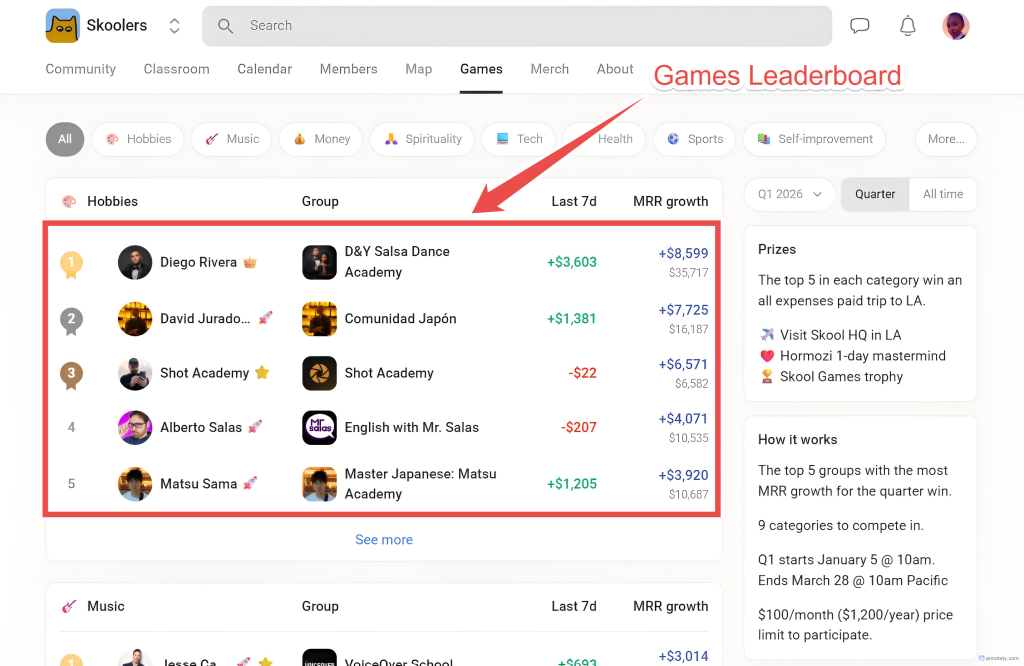
That creates a kind of self-sustaining engagement that doesn’t require you to nudge people every day.
The leaderboard adds public accountability and pulls members back in, and you can rename the levels to match your community’s theme.
It’s not limitless, though, because you can’t change the scoring logic or add fully custom rewards, and Skool skips extras like challenges and custom badges. But the core loop, points, levels, and leaderboard are tight, motivating, and flat-out fun, the main reason why skool communities so often feel more alive than communities on heavier platforms.
Mighty, on the other hand, has been adding gamification ever since, but it’s still trying to catch up.
You get streaks, profile recognition, and some basic badges, which is more than nothing.

Still, compared to Skool’s depth, it feels like a side feature the team added because members asked for it, not a philosophy the whole product was built on.
So while Mighty wins most feature categories on raw depth, this is the one place where Skool’s focus takes the gold.
My take: If daily, self-sustaining engagement matters to you, and for most course and coaching communities, that’s the entire ballgame, Skool’s gamification is the reason to pick it. Mighty’s works, but Skool’s is the one that turns a quiet community into a buzzing one without you doing the buzzing.
Skool vs Mighty Networks: Courses and Content
When it comes to courses, both platforms save you from paying for a separate tool like Teachable or Kajabi, yet they draw the line in slightly different places, and neither one goes as deep as a dedicated course platform.
Skool keeps course creation simple and tidy and centers your lessons around classrooms. You host your lessons, drip-feed them on a schedule, and organize modules in a structure that members move through easily.

And Skool now includes native video hosting with a generous 30GB file size limit, automatic captions, timestamps, playback speed controls, and HD quality that works on mobile and desktop.
That native video is a bigger deal than it sounds. It means you’re not embedding from YouTube or paying for Wistia, and the whole learning experience stays inside your Skool platform.
What you won’t find are quizzes, assessments, graded assignments, or completion certificates. So for anything that needs testing or credentialing, Skool comes up short.
Mighty, however, offers a more structured course experience, with clearer module organization and drip scheduling, and it supports both self-paced and program-style formats.

It’s the better pick if you want your curriculum to feel like a well-designed learning path rather than a plain list of lessons.
But it shares Skool’s limitations: there are no randomized question banks, multi-format quizzes, advanced grading, SCORM compliance, or certificates, which is where dedicated course tools still beat both of them.
Mighty also caps video uploads at 4GB, way below Skool’s 30GB, so heavy-video creators hit that wall a lot sooner on Mighty.
My take: If you want simple, video-driven courses wrapped in community, both platforms work well, and Skool’s bigger video limit gives it an edge for video-heavy creators. For structured multi-track programs, Mighty’s organization is nicer. But if you need real assessments or certificates, neither one will do, and I’ll come back to that.
Skool vs Mighty Networks: Engagement Tools
Skool leans on its leaderboard to keep people active, while Mighty leans on real-time chat and member matchmaking, so the two platforms pull your community in two different directions.
Skool’s engine is that gamified loop we just talked about, backed up by direct messages. But it has one notable gap: no group chats. That limits real-time, casual interaction, so your community lives in the forum feed and DMs rather than in live conversation channels.
There’s no problem with that, so long as your community is built around structured discussion and course progress, since the leaderboard keeps things humming. But if your members want to hang out in real time, the lack of a group chat stings.
Mighty, on the other hand, covers a broader range of the engagement spectrum. You get:
- A Chat space type that works like WhatsApp or Discord for real-time conversation
- Richer member profiles that people can sort by location, member type, or activity
- A built-in ambassador program with bronze, silver, and gold tiers that rewards members for inviting others

That ambassador program is a real growth tool that Skool doesn’t match natively. However, when a Chat space is wide open, members sometimes flock in these ambassador programs, leaving the rest of the community dead quiet. So it’s a feature you manage, not one you just flip on.
My take: Skool’s engagement is deeper in gamification but narrower in interaction, while Mighty’s is broader, with chat, sortable profiles, and an ambassador program, but relies more on you designing the experience. If gamified accountability is your engine, go Skool, but if real-time conversation and member-driven growth matter more, go Mighty.
Skool vs Mighty Networks: Events and Live Streaming
Skool has turned events into a real strength, while Mighty has long treated live streaming as a core feature, so what used to be a blowout is now a close fight.
Skool has come a long way and now pairs a native live call tool (Skool Call) with a full webinar tool (Skool Webinar), a community calendar, and event RSVPs right in the feed, which adds up to a complete live-events workflow you never have to leave the platform for.

That combination covers both kinds of live sessions you’d actually run. Skool Call handles interactive sessions where members join with a camera and mic, so it’s built for coaching calls, mastermind sessions, and group workshops where two-way participation is the whole point.
Skool Webinar, on the other hand, handles one-to-many broadcasts and supports up to 10,000 attendees on both plans. You can also promote specific members to speak when you want them on stage.
Both formats record automatically, and that’s a bigger deal than it sounds. You can reshare those recordings back into the community or repurpose them as course material, which turns every live session into evergreen content with zero post-production work.
Skool’s calendar also handles access control natively. You can restrict events to specific membership tiers or course enrollments, so if you run a premium coaching cohort inside a broader free community, your paid members see and RSVP for exclusive live sessions that free members can’t touch, and all of that segmentation happens without a separate Zoom account or scheduler.
Mighty takes events just as seriously, with rich event management features and native live streaming that lets you host community-wide events, webinars, and workshops, complete with scheduling and automated notifications, and members join right from mobile.

Its streaming is polished and feels like a built-in part of the community rather than a bolted-on link, which is what you’d expect from a platform that’s leaned on live programming for years.
My take: Skool’s native Call plus Webinar combo (with 10,000-attendee support, auto-recording, and tier-gated RSVPs) means it’s no longer the lightweight it once was, so a coaching or cohort community can run its entire live-events program inside Skool. Mighty still edges ahead on polish and flexibility for large, varied event programming, but if events are important to you, Skool is now a legitimate contender rather than an afterthought.
Skool vs Mighty Networks: AI Tools
Skool keeps it deliberately minimal, while Mighty went all-in with People Magic and its Co-Host AI.
Skool keeps AI light on purpose. Its entire design philosophy is simplicity, so it doesn’t try to be an AI powerhouse. It delivers a focused product and lets gamification and discussion do the work.
For creators who find AI features more distracting than useful, that restraint is part of the appeal, since there’s less to configure and less to ignore.
Mighty, on the other hand, leans hard into AI.
The AI Co-Host can take a single one-line idea and draft a community name, write a description, and assemble a sign-up page already loaded with copy and imagery, through what Mighty calls its Big Purpose Generator.

The practical effect is that the hardest part of any launch, staring at a blank page, mostly disappears. A creator with zero platform experience can go from an idea to a named community with a working landing page in minutes.
Beyond setup, People Magic suggests member matchmaking, surfaces connections between members, and offers conversation starters to keep the discussion moving. Output quality varies, and most hosts still tweak what the AI spits out, but as a starting point and an ongoing engagement aid, it’s a real head start that Skool doesn’t even attempt.
My take: If you want AI to speed up your setup and help spark member connections, Mighty wins this one decisively. If you’d rather have a simple platform that doesn’t ask you to babysit AI features, Skool’s restraint is a feature, not a flaw. It comes down to whether you see AI as a helpful co-builder or as noise.
Skool vs Mighty Networks: Customization and Branding
Skool lets you slap on a name and an image, then stops almost immediately, while Mighty lets you take branding all the way to a custom app.
Skool’s customization list is short. You can add a group icon, set a group name, upload a cover image, and switch between light and dark mode. That’s it.
You can’t:
- Use a custom domain
- Add brand colors or typography
- Put your logo in the forum header
- White-label the community
- Build a branded mobile app
That means every group you create lives under skool.com and looks like every other Skool community. That keeps things consistent and simple, sure, but it also means your brand basically dissolves into Skool’s.
Creators who don’t care about branding find no issue with Skool. But it’s a big problem for anyone building a branded business.
Mighty gives you a lot more room to make the community yours. You can style landing spaces, connect a custom domain, and add Google Analytics on higher tiers, plus a basic builder for web and landing pages.

Plus, its Mighty Pro tier offers fully branded, white-label iOS and Android apps, along with done-for-you services where their team builds the apps for you.
That branded app even lets your community live in the app stores under your own name rather than a platform’s brand.
My take: For branding and customization, Mighty is the goat, and its branded-app option on Mighty Pro is the standout. Skool’s near-total lack of customization is the price you pay for its simplicity. If your brand identity matters, Skool will frustrate you.
Skool vs Mighty Networks: Discovery and Growth
Skool has a built-in discovery marketplace that can feed you organic members, while Mighty has nothing like it, so you’ve got to bring your own crowd.
Skool includes a community discovery marketplace and search, so people can find and join communities by keyword, working a bit like Facebook groups.

That means a Skool community isn’t just a private room you have to fill entirely through your own marketing; it can pull in members who are actively searching for communities like yours. That’s a real growth channel inside the platform.
Skool also runs “Skool Games,” a monthly contest where community owners compete to attract paying members. It doubles as a growth motivator for you and a marketing engine for the platform.
Mighty has no equivalent public marketplace, so your community is yours to fill, which gives you more control and privacy but no built-in organic lead channel. You bring your own audience, full stop.
My take: If discoverability and organic growth matter to you, Skool’s marketplace is a legit advantage that Mighty flat-out doesn’t offer. It’s one of the best wins in Skool’s column, and worth considering if you’re starting without a big existing audience.
Skool vs Mighty Networks: Mobile Apps
Both apps are solid on iOS and Android, but only Mighty lets you put your own brand on one.
Skool’s app is fast and simple on both iOS and Android, mirroring the platform’s no-clutter feel so members can move through it easily. But it’s not branded. Members see Skool’s app, not yours, which ties right back to Skool’s overall lack of customization.
Mighty also has strong iOS and Android apps, and its comprehensive mobile experience is one reason its communities maintain high engagement. The bigger point is that on Mighty Pro, you get fully branded, custom native apps in the app stores under your own name, plus done-for-you services to build them, which Skool doesn’t match at any tier.
My take: Both apps are good, so for a standard member experience, it’s close. But if you want your community living in a branded app under your own name, Mighty is the only one of the two that pulls it off.
Skool vs Mighty Networks: Pricing Review
Skool is dirt cheap to start with flat, unlimited-member plans, while Mighty starts high and unlocks its depth on pricier tiers.
But neither one has a free plan. Both give you a 14-day free trial, and that’s it, so if you saw “free plan” somewhere, it’s outdated.
These are the real numbers from their live pricing pages.
Skool pricing (14-day free trial, no free plan):

- Hobby: $9/month, or $7.50/month billed annually. Unlimited members, unlimited courses, unlimited videos, unlimited live calls, and a 10% transaction fee.
- Pro: $99/month, or $82/month billed annually. Everything in Hobby, plus a lower 2.9% transaction fee, a custom URL, and affiliates.
What you must take note of about Skool is how flat it is. Unlimited members on every plan, with the difference between tiers coming down to admin limits, transaction fees, and a couple of Pro extras. That flat-rate model becomes more valuable as your community grows, since you never pay more just for adding members.
Mighty Networks pricing (14-day free trial, no free plan):

- Launch: $95/month, or $79/month billed annually. AI Co-Host, community, courses, and basic automations, with a 2% transaction fee.
- Scale: $215/month, or $179/month billed annually. Everything in Launch, plus more automations, multi-feature spaces, APIs and integrations, and migration services, with a 1% transaction fee.
- Growth: $425/month, or $354/month billed annually. Everything in Scale, plus advanced automations, simultaneous promotions, growth-expert sessions, and priority support, with a 0.5% transaction fee.
- Mighty Pro: custom pricing. Everything in Growth, plus custom-branded apps, full community-management services, advanced data reports, and custom storage, with a 0.5% transaction fee.
So how do they compare?
- Skool is way cheaper to start. Its Hobby plan is $9/month, and Pro is $99/month, while Mighty’s cheapest tier is $95/month, roughly the price of Skool’s top standard plan.
- Skool gets cheaper as you scale because unlimited members are included on every plan. Mighty’s advanced depth lives on its higher tiers, so growth costs you more.
- Mighty’s transaction fees are lower at comparable tiers (2% down to 0.5%) than Skool’s 10% Hobby fee, though Skool’s 2.9% Pro fee holds its own.
My take: On raw price, Skool wins, especially once you’re past a couple hundred members on its flat $99 Pro plan. Mighty costs more, but you’re paying for depth: spaces, branded apps, People Magic AI, richer events. “Cheaper” and “more capable” split right down the middle here. Skool’s the value pick, while Mighty’s the capability pick.
Skool vs Mighty Networks: Transaction Fees
Every sale you make hands a cut to the platform on top of your subscription, and here Skool’s entry-tier fee is brutal while Mighty’s quietly shrinks as you climb, so what you actually give up depends heavily on your plan.
Skool’s fees are simple but sharp on the entry tier: 10% on Hobby, 2.9% on Pro, on top of standard Stripe processing.
That 10% Hobby fee is rough at real revenue, so if you’re selling anything meaningful, Skool basically shoves you onto Pro fast, where the 2.9% becomes reasonable.
Let me put a number on it. Say you charge $30/month and have 100 members, that’s $3,000 in monthly revenue. On Hobby, Skool’s 10% takes $300 before Stripe even touches it. Move to Pro, and that drops to $87. Suddenly, the extra $90/month for Pro pays for itself many times over.
Mighty’s fees scale down by tier instead: 2% on Launch, 1% on Scale, and 0.5% on Growth and Mighty Pro, again on top of Stripe. So Mighty’s cut sits below Skool’s Hobby rate at every level and remains competitive with Skool’s Pro rate, which means that at higher revenue levels, Mighty can be gentler on your wallet than its higher subscription price suggests.
My take: Skool’s Hobby fee is a trap you escape by jumping to Pro. Once there, its 2.9% is fine. Mighty’s tiered fee structure rewards scale, sliding to 0.5% at the top. Either way, budget for the fee, not just the subscription, because at real revenue, the percentage the platform keeps matters as much as the monthly price.
Skool vs Mighty Networks: Pros and Cons
These are the advantages and drawbacks of building your community on either Skool or Mighty Networks:
Skool Pros and Cons
- Deep, built-in gamification (points, levels, leaderboards) that drives self-sustaining engagement
- A simple interface with almost no learning curve for you or your members
- Native video hosting with a generous 30GB limit, captions, and HD
- A built-in discovery marketplace that pulls in organic member leads
- Flat pricing with unlimited members on every plan, which gets cheaper as you scale
- Strong ecosystem recognition in the online-business, fitness, and coaching worlds
- Barely any customization: no custom domain, branding, white-label, or branded app
- One group per community, so no separate spaces for topics, cohorts, or courses
- No group chat, which caps real-time interaction
- No quizzes, assessments, or completion certificates
- A steep 10% transaction fee on the Hobby plan
Mighty Networks Pros and Cons
- Flexible Spaces that let you build multiple content tracks, tiers, and programs in one community
- Native live streaming and richer event management features for community-wide programming
- People Magic and Co-Host AI that speed up setup and spark member connections
- Fully branded, white-label mobile apps plus done-for-you app services on Mighty Pro
- Real-time chat, sortable member profiles, and a built-in ambassador program
- Lower transaction fees at comparable tiers, dropping to 0.5%
- No cheap entry tier; the lowest plan starts around $95/month
- A busier interface and steeper learning curve than Skool
- Lighter gamification than Skool despite recent additions
- A 4GB video upload cap, way below Skool’s 30GB
- No public discovery marketplace, so you bring your own audience
- Still no advanced course assessments or certificates
If you’re still torn on skool vs mighty networks, ask yourself one question: Do I want simple, gamified, and cheap (Skool), or deep, branded, and flexible (Mighty)?
But there’s a third answer you need to know about before you commit to either.
GroupApp: The Best Skool vs Mighty Networks Alternatives for Group Learning

A lot of comparison articles will just funnel you toward whichever platform pays them the bigger affiliate cut. But the truth is, Skool or Mighty Networks only works well for specific creators. The others have to find other alternatives.
Think about what these two platforms leave on the table.
Skool gives you gamification and simplicity, but locks you into a single feed, offers no real branding or group chat, and charges a 10% fee that punishes you until you upgrade.
Similarly, Mighty offers depth and branded apps but charges $95/month, with a learning curve and lighter engagement. Plus, both lack real course assessments, completion certificates, and pricing structures in which either your fees or your tier climbs as you grow.
If your community is a learning business, courses, cohorts, certifications, and structured programs, those gaps become major.
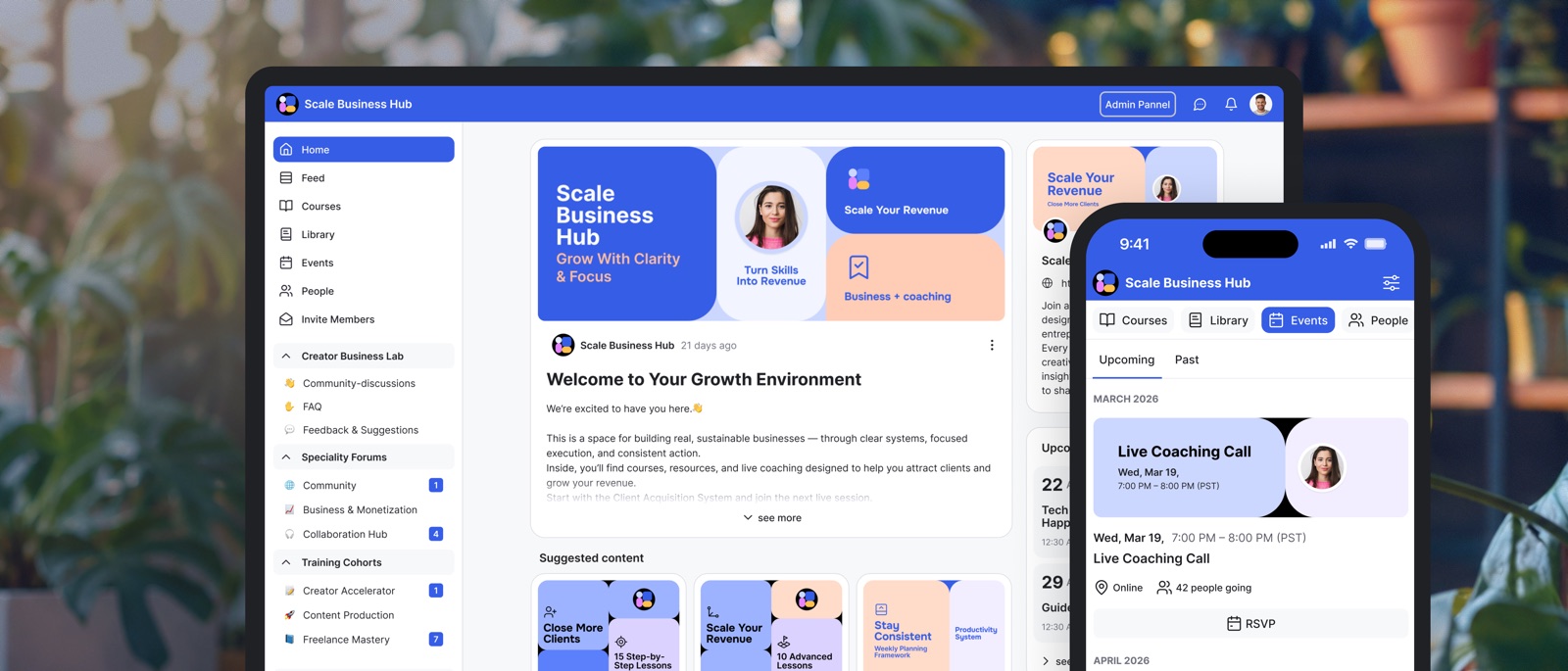
GroupApp is the group learning platform built for coaching and training programs, with a learning-first angle that Skool and Mighty only half cover. So instead of choosing between Skool’s simplicity and Mighty’s depth, GroupApp gives you what makes more sense for a learning community in one place.
Here’s where it does what neither of the other two can:
- Courses, community, and certification in one connected platform, so you’re not paying for a separate course tool to get the assessments and certificates that both Skool and Mighty lack.
- Discussion built into the learning experience, which keeps members engaged through completion instead of being scattered across a feed or a separate chat.
- Cohort programs where members move through the curriculum together, the structured, learn-together model Skool can’t build, and Mighty only approximates.
- 0% transaction fees on every plan, which is the one that should stop you cold, since Skool takes up to 10% and, Mighty starts at 2%, while GroupApp takes nothing from your sales.
- Native branded iOS and Android apps and white-label options as you scale, so your community carries your brand the way Mighty’s Pro tier promises, without Mighty’s price jump.
I won’t pretend GroupApp is the answer for everyone. If you want a pure gamified hangout with a leaderboard and nothing else, Skool’s loop is fun and hard to beat at $99 flat.
And if you want a sprawling multi-space membership empire with a branded app and don’t mind the cost, Mighty’s built for that.
But if you’ve read this far because your thing is about teaching people something and building a community around that learning, then the reason both platforms felt slightly off is simple: you were comparing two community tools for a learning job. GroupApp is the one I’d build that on, and with a free plan to start and 0% fees, there’s no real reason not to see for yourself.
The Bottom Line
Skool is the better pick for a simple, gamified, affordable community around your courses. If engagement and price matter most and you don’t need branding or advanced features, get Skool, jump on Pro to escape the 10% fee, and let the leaderboard do the work.
Mighty is the better pick for deep, branded, flexible communities. If you’re building something large with multiple spaces, live events, and a branded app, and you don’t mind the cost and the learning curve, Mighty is more capable across the board.
And if this whole comparison left you feeling like neither quite fits, that both felt like community tools when what you want is a place to teach and learn together, trust that instinct. You’re building a learning community, and you need a different tool entirely.
GroupApp is where I’d build it, and you can start free and keep 100% of what you earn while you figure out whether it’s the fit the other two weren’t.
Whatever you pick, go in with your eyes open. Now you know just what you’re getting, and just what you’re giving up.
Skool vs Mighty Networks: Frequently Asked Questions
Is Skool better than Mighty Networks?
For gamified engagement, simplicity, and price, yes. Skool’s leaderboard-driven engagement and flat $99 pricing win for simple course-and-community setups. But for depth, flexibility, branded apps, and events, Mighty is more capable. Your choice depends on whether you want simple and cheap or deep and branded.
Which is cheaper, Skool or Mighty Networks?
Skool, by a lot. Its Hobby plan is $9/month, and Pro is $99/month with unlimited members, while Mighty starts at $95/month (Launch) and climbs to $425/month (Growth) plus custom Mighty Pro pricing. Once your community grows, Skool’s flat $99 Pro plan is the clear value pick.
Does Skool or Mighty Networks have a free plan?
Neither one does. Both offer a 14-day free trial, and that’s it. Anyone telling you Skool or Mighty Networks has a permanent free tier is relying on outdated info. If you want a real free plan to start on, GroupApp offers one with 0% transaction fees.
Which platform is better for courses?
Both handle simple, video-based courses well, and Skool’s native video hosting with a 30GB limit gives it an edge for video-heavy creators, while Mighty’s structure is a bit more organized for multi-track programs. But neither platform offers quizzes, assessments, or completion certificates, so for real credentialing, you’ll want a dedicated course platform or a learning-first tool like GroupApp that folds courses, community, and certification into one.
Read our other reviews, comparisons, and alternatives surrounding Skool and Mighty Networks:
- Skool review
- Mighty Networks review
- Skool vs Circle
- Circle vs Mighty Networks in 2026
- Best Skool alternatives
- Best Mighty Networks Alternatives

Start your community for free today.
No commitment required.