
How to Run a Coaching Workshop in 2026 and Build a Business Around It

The first coaching workshop I ever sat through nearly put me to sleep. The coach knew her stuff, but for ninety minutes she talked ‘at’ twelve people who slowly sank into their chairs, checked their phones, and drifted off one by one. By the end of her presentation, half the room had left, mentally.
That boring experience taught me that a workshop lives or dies not on what you know, but on how you make people feel while they learn it. And the best facilitators know how to turn their knowledge into an experience that a room can’t look away from.
Today’s appetite for this kind of learning has never been higher, as the market for global corporate training could surpass $500 billion by 2030, according to statistics from Grand View Research. The coaching industry has grown into a multi-billion-dollar profession, with the International Coaching Federation reporting that over 100,000 coach practitioners worldwide generate billions in annual revenue. So the demand is real, the money is flowing, and workshops sit right at the center of it.
The only thing that decides whether you can share a slice of that opportunity is whether you can run a workshop people love, and by the end of this guide, you’ll know how to.
I’ll show you what a coaching workshop is, the different types you can run, the structure that keeps a room engaged, and give you dozens of coaching workshop activities and ideas you can steal. You’ll also learn how to promote and sell your workshop, and identify the best online workshop platform and workshop registration software to run the whole thing.
Let’s start with the basics.
Table of Contents
What Is a Coaching Workshop?
A coaching workshop is a structured, interactive event centered on a specific theme that provides participants with insight into the skills, techniques, methodologies, and best practices related to that topic. Unlike a lecture, where information flows one way, a workshop is designed for exchange, where people learn by doing, discussing, and practicing.
A lot of coaching workshops combine short lectures that explain coaching principles and case studies, hands-on activities like group discussions or practical coaching exercises, and, for in-person events, real networking opportunities. These events can run anywhere from a couple of hours to several days, and they happen both online and in person.
Now, a well-run coaching workshop builds your authority in your coaching niche, since teaching a room of people positions you as the expert. It also creates rapport with attendees and gives you a natural path to upsell them into your signature coaching program. On top of that, it lets potential clients experience your coaching process firsthand, building the trust curious attendees need to become paying clients.
With that foundation in place, let’s look at the different kinds of workshops you can run.
The 4 Main Types of Coaching Workshops
Every coaching workshop is different, so you must pick one that’s best for the audience you want to reach. These are the most popular types of workshops available for coaches:
- Leadership Coaching Workshop
It’s one of the most in-demand formats because organizations everywhere are investing heavily in developing their people. This kind of session is sometimes run as a leadership development workshop, offered as leadership development training, or folded into a broader leadership development program.
The workshop teaches managers and executives how to lead with clarity, communicate under pressure, and bring out the best in their teams. So if your niche is helping people step into bigger roles, a coaching workshop for leaders or managers puts you right where corporate budgets are flowing and pairs naturally with a leadership training program that you can upsell afterward.
Many coaches even package the workshops as a recurring leadership seminar series, since organizations happily pay for ongoing development rather than a single session.
- Executive Coaching Workshop
This workshop serves senior leaders who need a higher level of strategic and personal development. Where a general leadership session might cover the basics, an executive coaching workshop digs into the nuanced challenges of the C-suite, decision-making under uncertainty, leading through change, and the kind of self-awareness that separates good executives from great ones.
So this format commands premium pricing and is a natural choice for coaches pursuing an executive coach certification, since the credential reinforces the trust these high-stakes clients require.
- Life Coaching Workshop
The workshop serves individuals working on personal growth rather than professional advancement. These sessions help people clarify their values, set meaningful goals, and design a life that feels aligned, which is why topics like vision-boarding and values clarification consistently draw engaged audiences.
If you run life coaching programs or are working toward a life coaching certification, a workshop is the perfect on-ramp, because it lets prospective clients experience your approach before committing to a full coaching relationship.
- Business Coaching Workshop
This, along with a sales coaching workshop, targets entrepreneurs, business owners, and sales teams who want concrete results, more revenue, better systems, and stronger performance.
The sessions are practical as they teach frameworks people can apply immediately, making them easy to sell because the return on investment is tangible. So whether you’re focused on scaling a company or closing more deals, the promise of measurable outcomes is your strongest selling point.
Other specialized types, like a team coaching workshop (or group coaching workshop), work with an intact team to improve alignment, trust, and collaboration, which corporate clients value highly.
Similarly, an agile coaching workshop serves technology and product teams that want to adopt agile ways of working, which is a niche with real demand.
A career coaching workshop, on the other hand, helps people navigate job changes and transitions, while a somatic coaching workshop or public speaking coaching workshop serves more specialized personal-development audiences.
The field is broad, so you must choose the type that best aligns with your expertise and ideal client. Do that, and your workshop is already halfway to selling itself, because a session aimed at a specific audience with a specific need is far easier to fill than a general one that tries to appeal to everyone and connects with no one.
Now that you know which kind of workshop to run and who it serves, let’s discuss the structure that holds it all together.
How to Run a Coaching Workshop
To run a successful coaching workshop, you must follow a proven, repeatable structure that keeps the room engaged and energized from the very beginning to the end. And sure, every workshop has its own setup, but there are common elements that the best coaching workshops use to keep participants engaged and make learning effective.
This is the template I’d give any coach planning their next session:
Step 1: Open With Introductions and Set the Expectations
The first few minutes set the tone for everything that follows, so open your workshop by introducing yourself and any co-facilitators. Establishing your credibility and building rapport early is what makes people trust you enough to participate.
From there, give the room context by sharing the event’s main theme, why it matters, and the key learning outcomes people can expect. A group that knows where they’re headed is far more willing to come along for the ride.
You should also give your audience a clear breakdown of the agenda, tell them when breaks will occur, and, for workshops that handle sensitive themes, introduce a few group terms and conditions, such as refraining from judgment, to create a safe space where everyone can share.
The outcome you’re after here is a room that feels oriented, safe, and clear about the value ahead, because people who feel that way become curious and want to know more, while those who feel lost tend to check out early.
Step 2: Help the Group Get to Know Each Other
Your participants probably don’t know one another, and that unfamiliarity is a barrier to the open participation your workshop depends on. So the next obvious move is to help them connect.
If the group is small, go around the room and let everyone introduce themselves, sharing their name and background, why they joined, and, for a virtual workshop, where they’re located. These minor disclosures will build the trust that enables deeper sharing. Even a two-minute round of introductions can help turn a room of strangers into a group that feels like it belongs together.
To warm things up further, layer in a light icebreaker or a fun prompt, and it pays off to be a bit creative here.
You might ask people what they wanted to be as children, or run a quick “desert island” or “superpower” warm-up that gets everyone laughing and talking. A group that shares a laugh in the first ten minutes participates far more freely for the next ninety.
Do this correctly, and you’ll get a room that feels comfortable and connected, which makes a big difference for small-group workshops where the value comes from what people are willing to reveal.
Step 3: Present Your Key Concepts Without Losing the Crowd
With the group settled and connected, it’s now time to deliver your first lesson, and this is exactly where the workshop I described at the introduction went so wrong. So let me show you how to do it right based on my 8 years helping creators build learning businesses.
Your opening lecture should help participants understand your workshop’s core concepts. If you’re running a longer event, structure those concepts so they build on each other logically, because a clear flow is what lets people follow along instead of getting lost.
So map your teaching as a progression, with the foundations first, complexity later, and your audience will stay with you the whole way.
The real skill, though, is delivering that content without triggering the glazed-over stare I watched consume that first workshop, and the solution is to break up your lectures relentlessly.
Punctuate your teaching with visual aids and direct questions to the room, because participation keeps attention alive and dramatically improves retention, which is especially true for virtual workshops where the temptation to multitask is just one click away.
You can also use real-life case studies because they show the practical application of the tools you’re teaching and make abstract ideas concrete. And always, always allocate time for questions before moving on, because letting people seek clarification stops confusion from growing into disengagement.
Done well, and your participants will be actively thinking rather than passively absorbing information.
Step 4: Run Interactive Exercises
If lectures are the skeleton of your workshop, interactive exercises are its beating heart, because they’re where participants stop hearing about skills and start using them.
Group exercises immediately show people how to apply what they’ve just learned and allow attendees to learn not only from you but also from each other.
But the exercise you pick depends on your topic.
For coaching skills training, role-plays work beautifully. You can put people in groups of three, with one playing the coach, one the coachee, and one the observer, so everyone experiences the process from multiple angles. But if you’re teaching something like website copywriting, a solo exercise where each person drafts real copy and gets your feedback right after will serve them better than a role-play.
Breakout sessions with three to five people are also a great way to create space to share insights safely. You just need to alternate short lectures with practical exercises, because that back-and-forth is the most effective way to teach multiple concepts in a short window and keep energy levels high.
With that, your participants will leave not just knowing something new, but able to do something new, which is what they came for.
Step 5: Build in Reflection
Learning that isn’t reflected on tends to evaporate, so after the exercises, give your participants dedicated time to process what they’ve absorbed.
You can guide them by offering writing prompts for individual reflection, creating small sharing circles where people discuss their key takeaways and brainstorm how to apply them, or running a final Q&A where you answer lingering questions and give constructive feedback.
This way, participants will walk away feeling complete rather than overwhelmed. Besides, a person who leaves your workshop clear on what they learned and how they’ll use it will tell their friends about it, come back for your next one, and consider your paid coaching program. On the other hand, a person who leaves foggy and unsure will disappear.
So never skip reflection to squeeze in more content.
Step 6: Close With Purpose and a Path Forward
How you end your workshop greatly affects what people remember and what they do next, so close with intention rather than just letting the session fizzle out.
Your final segment should briefly summarize the key topics you covered, reinforce the main takeaways, and lay out a few concrete next steps your attendees can take to apply what they learned.
This closing is also your most natural opportunity to invite people deeper into your world, and doing it well will feel like a generous offer rather than a sales pitch. Start by sincerely thanking your participants, letting them know how to follow or contact you, and sharing a little about your coaching packages or courses for those who want to keep learning with you. After all, the people who just spent hours experiencing your teaching are the ones most ready to say yes to more.
If you follow these steps to the letter, your participants will leave your coaching workshop energized and equipped, and a lot of them will take the next step with you. That’s how a single workshop becomes the top of a funnel that feeds your entire business.
With the structure locked in, let’s move on to the activities.
Coaching Workshop Activities and Ideas
Coaching workshop activities will make your session engaging, interactive, and unforgettable. So the following is a list of proven activities and workshop ideas across the main coaching niches, organized so you can grab whatever works for your audience.
The best way to choose, by the way, is to build your workshop around the single biggest pain point your target audience faces.
Let’s start with life-coaching workshop ideas, since personal growth topics attract some of the most engaged audiences.
- A Vision Board Creation Workshop teaches people to visualize their goals and aspirations, and it works well because it’s hands-on and emotional.
- A Values Clarification Session helps participants identify their core values and align their lives with them, delivering the clarity people crave.
- A Goal-Setting and Action-Planning Intensive walks people through setting SMART goals and building a concrete 90-day plan, which is powerful on its own and easy to upsell from.
These workshop activities double as both transformation and lead generation.
For career coaching workshop ideas, the goal is to help people take control of their professional lives.
- A Personal Branding Workshop helps clients define and communicate their unique value, which matters more than ever in a crowded job market.
- A Networking Mastery Training teaches proven strategies for building relationships to expand professional networks.
- A Career Transition Intensive guides people through job changes, promotions, or the leap into entrepreneurship.
A career coaching workshop meets people at the point of motivation, when they’re most likely to invest in your help.
Business and sales coaching workshop ideas should be based on measurable outcomes.
You might run:
- A Business Coaching Fundamentals Training covering strategic planning and growth strategies.
- A Scaling Workshop teaching entrepreneurs how to grow from a small operation into a team-driven business.
- A Sales Conversation Intensive that drills down into the frameworks for closing more deals.
And because these workshops promise revenue and results, they’re among the easiest to fill and to price at a premium.
For a leadership or team coaching workshop, the activities focus on alignment, communication, and self-awareness, which corporate clients value most.
These are the ideas you can use in your next session:
- Courageous Conversations exercise that teaches leaders to handle difficult discussions.
- A Team Alignment Workshop that gets an intact team rowing in the same direction
- A Coaching Fundamentals session that teaches managers to coach rather than command, similar to coaching skills training for managers that companies actively buy.
You can even mix and match these activities based on your topic and audience to create a session that stays lively from start to finish.
Now that you know what to run and how to run it, let’s talk about where to run it.
The Best Platforms to Run Your Coaching Workshop On
The tool you use to run your workshop affects the experience almost as much as the content itself, because a fragmented setup will frustrate participants and hide the transformation you worked so hard to deliver.
In that case, choosing the right online workshop platform and workshop registration software will decide whether your workshop feels professional or amateur, whether people show up, and whether they come back.
And the biggest mistake I see coaches make all the time is using five separate tools to run their business, like Zoom for calls, a course tool for content, a community app for discussion, a registration form somewhere else, and a payment processor on top of everything. They then wonder why the experience feels disjointed and why they spend more time managing software than coaching people.
So as you weigh your options, have a look at these features that every great coaching workshop platform has:
- Registration and payment in one place, so people can sign up and pay without you having to manage a separate form and checkout tool.
- Live session hosting that’s quick to set up and easy for participants to join, whether it’s a native feature or handled through a smooth Zoom or Google Meet integration.
- A place for learning, since a workshop that leaves no trace (no replay, resources, or follow-up community) misses most of its long-term value.
- Community and discussion, because the peer connection that makes group learning effective needs a home.
- The ability to sell what comes next, so your workshop can flow naturally into a paid program, membership, or course.
With those criteria in mind, here are the best platforms for the job.
1. GroupApp: Best for Coaches Running Workshops as Part of a Program

If your workshop is a one-off you’ll never build on, almost any tool will do.
But if you’re a coach who wants your workshop to be the entryway to a real coaching business that turns attendees into program members, then GroupApp is the platform I’d recommend.
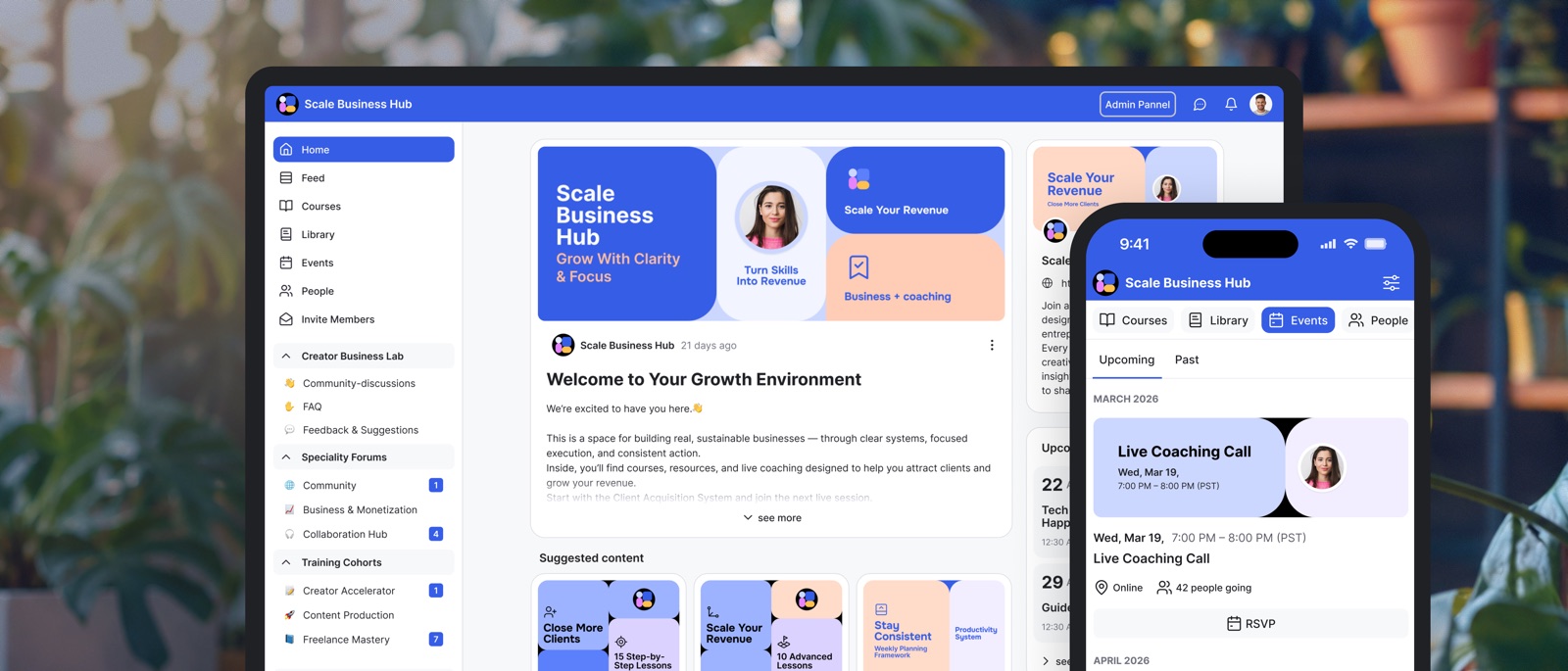
GroupApp is a group learning platform built for coaching, training, and certification programs. Where most tools will treat a workshop as an isolated event, GroupApp treats it as the first step in a structured, social learning experience. That way, you can host the live workshop, keep the recording and resources organized in one place, drop attendees into a community that keeps the momentum going, and sell them into your signature program, all inside one platform.
On GroupApp, your workshop grows your business with the following tools:
- Native events: You can schedule your workshop as free or paid, set recurring sessions, collect RSVPs, send automated reminders, and handle time zones automatically. When the session ends, the replay is attached directly to the relevant program week, so attendees can find it in context rather than chasing a Zoom link.
- Built-in registration and checkout: People sign up and pay in one flow, with flexible pricing, payment plans, and coupon codes, so you never have to integrate a separate workshop registration software or a third-party checkout.
- Cohort discussion channels: They give your workshop attendees a place to connect, share wins, and hold each other accountable between sessions, which is the peer dynamic that turns a one-time workshop into an ongoing community.
- Courses and a resource library: You can turn your workshop content into a structured program or a library of replays, frameworks, and workbooks that members can access anytime, allowing you to monetize the material you already created.
- A branded iOS and Android app: Available on higher tiers, it lets attendees experience your workshop and everything after it under your own brand, with push notifications that bring them back.
- 0% transaction fees on every plan: You keep 100% of what you earn from your workshop and everything you sell after it, since GroupApp never takes a cut of your sales beyond standard Stripe processing.
Best for: Coaches and trainers who want their workshop to feed a real coaching program, membership, or certification, not just run as a standalone event.
Pricing: GroupApp starts with a free plan at $0/month (perfect for running workshops and recurring learning events), then Build at $65/month ($57 billed annually) for courses and landing pages. The Scale plan starts at $145/month ($127 billed annually) for automation, certificates, and white-labeling, and a Branded App plan at $485/month for a fully branded mobile app. Every plan carries 0% transaction fees, and with 1,100+ coaching and training programs already running on it, it’s proven at this job.
2. Zoom: Best for Simple Live Video Delivery

When all you need is a reliable way to get faces on a screen, Zoom is the default tool that almost everyone already knows how to use.
For a coach running a straightforward virtual coaching workshop, Zoom handles live video, screen sharing, and breakout rooms for interactive exercises, and its familiarity means participants can join without a learning curve.
Zoom’s breakout rooms are useful for the small-group exercises and role-plays that sit at the heart of a good workshop. Plus, its recording feature captures your session for later, and webinar mode scales to larger audiences when you need it.
The catch is that Zoom is only the live piece, which means it solves one part of your workshop and leaves the rest to you.
There’s no built-in registration beyond basic sign-up, a community for attendees to connect in afterward, a place to house your content or sell your next offer, or any way to keep the momentum going once the call ends. So Zoom works best paired with other tools.
Best for: Coaches who want dead-simple live video delivery and are fine managing registration, community, and sales elsewhere.
Pricing: A free Basic tier covers 40-minute meetings for up to 100 participants, with paid plans at $16.99/user per month (Pro, or $14.16 annually) and $21.99/user per month (Business, or $18.33 annually), plus a custom Enterprise tier.
3. Eventbrite: Best for One-Off Workshop Registration and Ticketing

If you only need to register people and charge them for a single event, Eventbrite is the tool most people reach for because it’s built specifically for event ticketing and discovery.
For a coach running a standalone coaching workshop, Eventbrite handles the registration page, ticket sales, and attendee management, and its built-in marketplace can even put your workshop in front of people already searching for events like yours.
The platform gives you a professional registration page fast, processes payments, sends confirmations and reminders, and its audience can generate sign-ups you wouldn’t get from a private page, which really helps when you’re trying to build a name for yourself. So, as workshop registration software for a one-off event, it’s a solid, low-friction choice.
The limitation is that Eventbrite is a registration tool, not a workshop home, so it stops at the ticket.
It doesn’t host your live session, house your content, build a community, or sell your next program, and it charges per-ticket fees that add up as you grow. So Eventbrite fits the coach who wants easy registration for a single event and to handle delivery elsewhere, instead of building an ongoing coaching business.
Best for: Coaches selling tickets to a one-off, public workshop who want built-in registration and discovery.
Pricing: Free to publish unlimited free events, while paid tickets carry a 3.7% + $1.79 service fee per ticket plus a 2.9% payment processing fee per order (passed to buyers by default).
4. Teachable: Best for Turning a Workshop Into a Self-Paced Course

Sometimes the best thing you can do with a great coaching workshop is capture it once and sell it forever, and that’s where Teachable comes in, since it’s built for packaging knowledge into self-paced online courses.
For a coach who wants to record a workshop and turn it into an evergreen product, Teachable gives students a polished experience as they move through lessons at their own pace.
The platform lets you host video lessons, structure modules, sell with a built-in checkout, and even manage tax compliance through its payment system, so you can turn your workshop into a product that sells on autopilot.
The trade-off is that Teachable is built for individual, self-paced learning, which is the opposite of what makes a live workshop special. There’s no native live workshop hosting, cohort community, or group dynamic, as it delivers to students one at a time.
So, Teachable works best for the coach who wants to monetize a recorded workshop as a course, but it isn’t built to run the live, interactive, group experience that a real coaching workshop depends on, which is where a group learning platform pulls far ahead.
Best for: Coaches who want to package a recorded workshop into a self-paced course rather than run live, interactive sessions.
Pricing: Plans start with the Starter plan at $39/month ($29/mo billed annually), plus a 7.5 transaction fee. Then Builder at $89/month ($69/mo billed annually), Growth at at $189/month ($139/mo billed annually), and a custom pricing tier for high-volume education businesses that need custom tools and premium support.
5. Regpack: Best for Complex, High-Volume Workshop Registration

For coaches and organizations running large or logistically complex workshops, especially recurring training programs with lots of attendees, Regpack specializes in the heavy-duty registration and payment management that simpler tools can’t handle.
It’s built specifically for the registration-and-billing side, with conditional forms, automated payment plans, and detailed attendee tracking.
Regpack handles multi-step sign-up flows, collects the data you need using conditional logic, manages installment payments automatically, and provides robust reporting on who’s registered and paid. So, as dedicated workshop registration software for a high-volume operation, it’s a capable choice.
The limitation, as with the other specialists, is its scope.
Regpack manages registration and payments, not the workshop itself. It doesn’t host your live sessions, deliver your content, or build community, and it’s more of a tool than a solo coach running intimate workshops needs.
So Regpack works best for organizations and training providers with serious registration complexity, while most individual coaches will find it more than the job requires.
Best for: Organizations and training providers running large or complex workshops that need advanced registration and payment management.
Pricing: Custom, with one unlimited plan across SMB, Mid-Market, and Mid-Market Plus tiers (unlimited projects, users, and forms), plus payment processing as low as 1.5%.
Which Platform Should You Choose?
The choice comes down to what your workshop is for.
- If you just need to host one live session, Zoom handles it.
- If you’re selling tickets to a single public event, Eventbrite gets you registered fast.
- If you want to package a recording as a self-paced course, Teachable does that.
- If you’re running large, complex training with heavy registration needs, Regpack manages the logistics.
But if you’re a coach who wants your workshop to feed a real coaching program, build a community that keeps people coming back, and grow your revenue beyond a single event, then GroupApp is the platform built for that.
Be sure to match the platform to your ambition, and if your ambition is a successful coaching business rather than a single afternoon, the choice becomes obvious, doesn’t it?
Now, whichever platform you pick, you still have to fill the room, so let’s talk about promotion.
How to Promote and Sell Your Coaching Workshop
Selling a workshop is far more approachable than it sounds once you understand that it runs on trust and visible value rather than an aggressive sales pitch.
The following steps will help you fill your workshops, as they always do for mine.
1. Start By Nailing Your Positioning
A workshop that promises a specific, desirable outcome sells far better than one with a vague theme.
So instead of “A Leadership Workshop,” promise “How to Have the Hard Conversations Your Team Is Avoiding”, because the specific transformation is what convinces someone to sign up. And that clarity ties back to choosing your topic around a real pain point, since a workshop that solves an urgent problem practically markets itself, while a general one struggles no matter how good the content is.
2. Build a Simple Funnel That Leads With Value
One of the most reliable ways to fill a paid workshop is to give away something valuable first, like a free mini-training, a helpful guide, or a short live session, because letting people experience your teaching builds the trust that drives the purchase.
So share some useful content in your niche through articles, social posts, or a free lead magnet, collect emails from the people who engage, and nurture that list with insight until your workshop feels like the obvious next step.
3. Use Your Existing Audience and Partnerships
The fastest path to a full workshop is often through people who already know you. So email your list, post across your social channels, and consider partnering with other coaches or organizations who serve your ideal client.
And don’t underestimate the power of running a coaching workshop for an organization directly, since a corporate contract for a leadership or team coaching workshop can be worth more than dozens of individual tickets, and those clients often come back for more.
4. Make Registration and Payment Effortless
Every extra step between “I’m interested” and “I’m registered” costs you more attendees. So use a platform where people can sign up and pay in a single flow, ideally in the same place where your workshop will happen.
This is why running your registration on the same platform as your workshop, rather than juggling separate workshop registration software and a payment processor, pays off, both in conversions and in the impression you make.
Get promotion right, and you’ll have a full room, which brings us to the question everyone eventually asks: what should you charge?
How to Price Your Coaching Workshop
Price your workshop on the transformation it delivers, not on the hours it takes, because people pay for outcomes, not for your time.
These are the right steps that will help you charge your worth.
Step 1. Anchor your price to the value, not the length.
A half-day coaching workshop that helps a business owner find a solution to a problem costing them thousands is worth far more than its runtime suggests, so resist the urge to price by the hour. Instead, ask what the result is worth to your ideal attendee and price accordingly.
A coaching workshop that makes someone a better leader, or helps someone land a better job, delivers value that beats a modest ticket price. So the bigger and more specific the outcome, the more room you have to charge with confidence.
Step 2. Match your price to your audience and method
Different workshops command different rates. For example, a life coaching workshop for individuals might be priced at an accessible level to fill the room and feed your funnel, while an executive coaching workshop or a corporate team coaching workshop can command premium pricing because the buyer’s budget and the stakes are higher.
So be sure to segment the workshop categories because consumer workshops often win on volume and lead generation, while corporate and executive workshops win on high-ticket value. And remember that a low price can sometimes signal low value, so don’t underprice a premium experience just because you’re nervous.
Step 3. Use a pricing structure to capture more attendees
Offering an early-bird rate rewards fast decision-makers and creates urgency, payment plans make higher-ticket workshops accessible to more people, and tiered options (like a basic ticket plus a VIP tier with a follow-up coaching call) let different budgets say yes.
So a platform with flexible pricing, payment plans, and coupon codes built in makes this easy to set up, as it raises your total revenue without lowering your headline price. When you get the pricing right, your workshop will become not just a great experience for all participants but also a profitable one, which is the whole point of running it as a business rather than a hobby.
Common Mistakes That Ruin a Coaching Workshop (and How to Avoid Them)
Even with a great plan, there are a few avoidable missteps that can undercut your coaching workshop, and the following are the ones creators and coaches make most often:
- Lecturing instead of facilitating: That’s the same mistake that ruined the first workshop I ever attended, because when you talk at people for too long, their attention collapses. The solution is short teaching followed by interactive exercises, because a room doing the work remains engaged, while a room only listening to one person speak tends to drift away. So if you catch yourself planning to talk for thirty straight minutes, break it up immediately.
- Skipping the connection and reflection steps: A workshop isn’t measured by how much you covered, but by how much people retain and can use, and connection and reflection are what make learning more effective. So protect those phases because a workshop that teaches less but transforms more beats a one that leaves people overwhelmed every single time.
- Running everything on a fragmented stack of tools: When attendees register in one place, join the call in another, find resources in a third, and get follow-up in a fourth, the whole thing feels exhausting and unprofessional, which lowers the perceived value of your coaching. Consolidate everything into one platform where registration, delivery, community, and follow-up all live together to make your workshop feel like the premium experience it should be.
- Treating the workshop as the finish line rather than the start: The people who just spent hours experiencing your teaching are the warmest leads you’ll ever have, so a workshop without a clear next step, invitation into your program, or community to stay part of wastes the trust you just built. So always design your workshop to flow into what comes next, because that’s how a single event becomes the engine of an ongoing coaching business.
If you can avoid these four pitfalls, you’ll be well ahead of most coaches running workshops today.
How Coaching Workshops Fit Into Certification and Career Growth
If you’re serious about coaching as a profession, workshops don’t just serve your clients; they serve you too, because running and attending workshops is one of the most practical ways to build the credibility that grows your career.
And credibility in this field increasingly runs through certification, so you must understand how workshops connect to the broader world of coaching certification and professional development.
On the client-facing side, a coaching workshop is a powerful way to demonstrate the expertise your credentials represent. When you hold an ICF coaching certification, for example, or you’re a certified executive coach, a workshop lets prospective clients experience the skills behind the credential firsthand. So your certifications and your workshops reinforce each other: the credential builds trust before people arrive, and the workshop proves that trust was warranted.
That’s why many coaches pursuing an executive coach certification or working through life coaching certification programs run workshops alongside their studies, since teaching what you’re learning is one of the fastest ways to master it and market yourself at the same time.
On the growth side, understanding how certification works will help you plan your own path.
The International Coaching Federation (ICF) is the most recognized accrediting body because ICF credentials signal a standard of training and ethics that clients and employers respect. So whether you pursue ICF coaching certification directly, enroll in ICF-accredited coaching programs, or build your skills through coaching skills training, each step raises the level at which you can run workshops and the fees you can command.
And beyond the ICF path, a wide range of coaching courses, online coaching certification programs, and specialized credentials let you deepen a niche, which in turn sharpens the workshops you offer in that niche.
Your workshops and your professional development feed each other in a virtuous cycle. So attending a coaching and mentoring workshop sharpens your own facilitation.
And a platform that lets you run everything from a free introductory coaching workshop to a full certification program in one place makes that journey far smoother, which is one more reason your platform choice matters as much as it does.
Virtual vs In-Person Coaching Workshops: Which Should You Run?
When deciding whether to run your coaching workshop online or in person, you must understand the trade-offs of each approach and your niche’s requirements. The best choice depends on who you’re serving and what you want the workshop to achieve.
Virtual Coaching Workshop
This approach is easier and more affordable, especially for new coaches. Running online means you can fill a room with people from anywhere, with no venue to rent, no travel, and no geographic ceiling on who can attend.
The trade-off is that virtual sessions demand more deliberate engagement, since it’s easier for people to multitask or drift off behind a screen. That’s why the interactive activities, breakout rooms, and reflection steps we covered are essential for online use.
So a virtual workshop is the accessible, scalable choice, and with the right online workshop platform, it can feel just as connected as being in the same room.
In-Person Coaching Workshop
By contrast, in-person workshops offer a deeper connection and premium positioning, which makes them powerful for high-value offers. Being physically together creates a level of trust, energy, and networking that’s hard to replicate on a screen.
The trade-offs are real, though, since you’re limited to people who can travel, and you incur venue, catering, and logistics costs that eat into your margins. So, in-person works best when the transformation and the price point justify the added cost and the smaller reach.
The smartest coaches run hybrid workshops that combine the best of both.
You might deliver the core teaching in person for a premium in-room experience while streaming to a virtual audience, or run a virtual workshop that flows into an in-person retreat for your most committed participants.
The Bottom Line: Run Workshops That People Remember
A great workshop is a designed experience that opens with connection, teaches in engaging bursts, puts people to work in interactive exercises, gives them time to reflect, and closes with a clear path forward.
It’s built around a specific transformation your audience is hungry for. That could be a leadership coaching workshop for managers stepping up, a life coaching workshop for people seeking clarity, or a team coaching workshop for an organization that wants its people aligned.
Plus, it runs on a platform that removes friction across registration, delivery, community, and what comes next, so the whole experience feels seamless rather than stitched together.
Most of all, remember that a workshop is rarely the destination, but is almost always the doorway. Because the people who spend hours learning from you are the warmest, most ready audience you’ll ever have.
So, a workshop designed to flow into your coaching program, membership, or certification is a workshop that builds a business. So plan the experience with care, run it on a platform built for the entire journey like GroupApp, and let each workshop be the first step in a lasting relationship.
That’s how you turn the expertise you already have into the transformation people remember, and the coaching business you’ve been working toward.

Frequently Asked Questions About Coaching Workshops
How long should a coaching workshop be?
A coaching workshop can run anywhere from a couple of hours to several days, depending on your topic and format. A focused, single-outcome workshop (like a goal-setting session), for example, often works well in two to three hours, while a deeper skill-building experience might need a full day, and an immersive retreat can span multiple days. To get it right, you must match the length to the transformation you’re delivering, then structure the time with the alternating lecture-and-exercise activity that keeps people engaged no matter how long the session runs.
How do I price a coaching workshop?
Price your coaching workshop on the transformation it delivers rather than its length, since people pay for outcomes, not hours. You can anchor your price to what the result is worth to your ideal attendee, align it with your audience, and use structures like early-bird rates, payment plans, and tiered options to attract more attendees. A platform with built-in flexible pricing and payment plans, like GroupApp, makes this easy, allowing you to increase your total revenue without lowering your headline price.
Can a coaching workshop grow my coaching business?
Absolutely, and it’s one of the best tools for it, because a coaching workshop works as the front door to your entire business. It builds your authority, lets prospective clients experience your teaching firsthand, and creates a natural path into your paid coaching program, membership, or certification. So when you run your workshop on a platform like GroupApp that connects registration, delivery, community, and monetization, a single event can feed a program that feeds a membership. That’s how workshops stop being events and become the engine of a thriving coaching business.
We have other similar resources that will help you build a successful coaching business:
- How to Start an Online Coaching Business From Scratch (And Get Your First Paying Clients)
- 10 Best Online Coaching Platforms (2026): Tested & Compared
- Marketing for Coaches: 9 Proven Strategies
- The 5 Powerful Coaching Models Top Earners Swear By

Start your community for free today.
No commitment required.